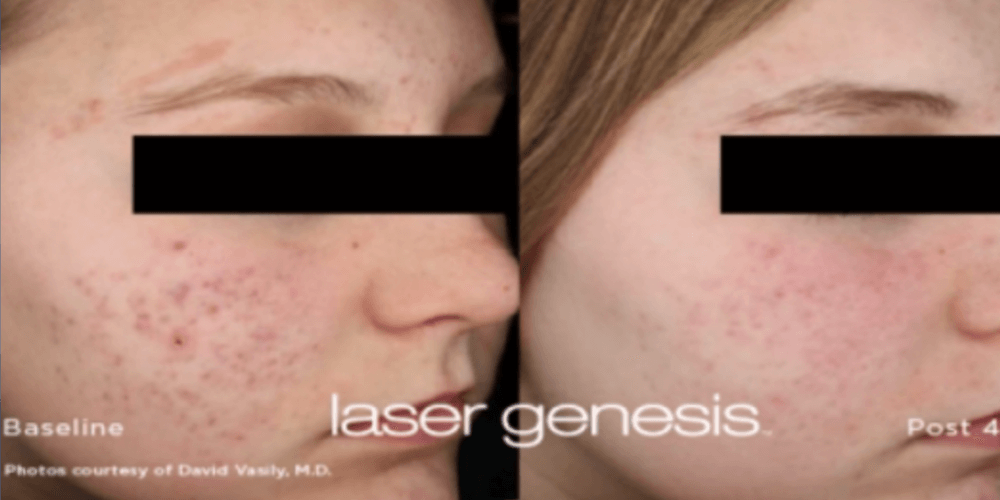
Acne scarring forms when the skin’s repair process is disrupted by inflammation, leaving behind uneven texture, shallow depressions or lingering redness long after the breakouts themselves have settled. Laser Genesis is one of the gentler options used for this at our Kent Town clinic in Adelaide, and it is often chosen by people who want to work on scarring gradually rather than commit to an ablative treatment with significant downtime.
It is not the right answer for every kind of scarring. Understanding what it does well, and what it does not, is the most useful place to start.
How Laser Genesis works on acne scarring
Laser Genesis delivers thousands of low-energy micro-pulses into the upper dermis without breaking the surface of the skin. That gentle, cumulative heating does two things at once, which is why it suits post-acne skin in particular.
The first is collagen stimulation. Warming the dermis encourages the skin to produce new collagen over the following weeks and months. As that collagen builds, shallow depressed scarring can begin to look less pronounced because the tissue underneath is fuller than it was.
The second is vascular. Much of what people describe as acne scarring is not scarring at all, but post-inflammatory erythema, the flat red or purple marks left behind after a breakout. The same wavelength targets the small dilated capillaries feeding that redness, which can help the marks fade more quickly than they would on their own.
Which types of acne scarring it suits
Laser Genesis tends to be considered for the shallower end of the scarring spectrum. Because it works without breaking the skin surface, it is a gradual treatment rather than a dramatic one.
- Rolling scars with soft, sloping edges, where added collagen can reduce the shadowing that makes them visible
- Shallow textural irregularity across the cheeks or temples rather than isolated deep marks
- Post-inflammatory erythema, the flat red or purple marks left after breakouts
- Enlarged pores and general roughness that often accompanies long-standing acne
Deep ice-pick or boxcar scarring generally responds better to other approaches. In those cases the clinic may discuss subcision for tethered acne scarring or a resurfacing option, either instead of Laser Genesis or alongside it. Many people end up with a combination rather than a single treatment, and what suits you depends on your scar type, your skin and how your skin has behaved in the past.
If active breakouts are still occurring, settling those usually comes first. There is little value in treating scarring while new lesions are still forming, so the clinic will often talk through acne treatment options in Adelaide before starting any scar work.
| Feature | Laser Genesis | Ablative resurfacing |
|---|---|---|
| Skin surface | Left intact | Removed in a controlled way |
| Downtime | Usually a few hours of pinkness | Days to weeks |
| Sessions | A course of four to six | Often one to two |
| Best suited to | Shallow scarring and redness | Deeper structural scarring |
| Anaesthetic | Not usually required | Commonly required |
What a session is like
The handpiece is passed back and forth over the treatment area in slow sweeps, building warmth gradually. Most people describe it as a warm sensation rather than a sharp one, and no anaesthetic is typically required. A session usually runs somewhere around 30 minutes depending on the area being treated.
Afterwards the skin often looks slightly pink, similar to mild sun exposure, and that generally settles within a few hours. Most people return to their usual activities the same day.
- Arrive with clean skin and no makeup on the treatment area
- Expect warmth that builds through the session rather than sharp pulses
- Eye protection is worn throughout
- Mild pinkness afterwards, usually settling the same day
- Moisturiser and SPF straight afterwards, makeup once the redness has gone
How many sessions are usually needed
Because the result depends on your own collagen production, a course is typical rather than a single visit. Clinics commonly work in the range of four to six sessions spaced a few weeks apart, with changes appearing gradually over the months that follow rather than immediately afterwards.
Individual response varies. Some people see useful improvement in texture and redness, others see less, and outcomes are not guaranteed. An assessment is the only way to get a realistic sense of what your skin is likely to do.
A few things tend to influence how much change is possible. Scar depth is the largest factor, since surface heating can only do so much for tissue that is tethered well below the dermis. Age matters too, because collagen response slows over time.
Smoking and poorly controlled diabetes both affect wound healing and can blunt the result. And skin that is still actively breaking out will keep producing new marks faster than a course can address the old ones.
Maintenance sessions are common once an initial course finishes. Collagen turnover continues regardless of treatment, so people who were happy with the change often return periodically rather than treating once and stopping. That is a decision to make after seeing how your skin responded, not something to commit to at the start.
Acne scarring is not one condition. Rolling, boxcar and ice-pick scars respond differently, and most people have a mix. An assessment identifies which you have before any treatment is chosen.
Risks and things to consider
All laser treatments carry risk. Possible effects include prolonged redness, swelling, blistering, and changes in pigmentation, which can be more of a consideration in deeper skin tones. Rarely, treatment can cause scarring of its own.
Sun exposure matters more here than people expect. South Australian UV levels are high for much of the year, and treated skin is more reactive than usual, so sun protection before and after a course is part of the treatment rather than an optional extra. Recent sun exposure or a tan may mean treatment is postponed.
- Avoid deliberate sun exposure and solariums for several weeks before a session
- Use broad spectrum SPF50+ daily through the course and afterwards
- Tell the clinic about any recent tanning, including fake tan, before treatment
- Expect the course to be rescheduled if your skin is sunburnt or freshly tanned
- Keep the treated area covered during peak UV in the days after a session
Pigmentation change is the risk most closely tied to sun exposure, and it is the one that takes longest to resolve. Guidance on UV protection in Australia is published by the Better Health Channel, alongside general information on acne and its after-effects.
Some skin conditions, medications and recent treatments can make laser unsuitable, which is why a consultation with a registered health practitioner is required before starting. You can read more about acne and scarring generally at healthdirect’s information on acne.
When it may not be the right choice
Being clear about the limits saves disappointment. Laser Genesis is generally not the first option in these situations.
- Deep ice-pick scarring, where the tethering sits too far below the surface for non-ablative heating to reach
- Raised or keloid scarring, which behaves differently to depressed scarring and needs another approach
- Active, inflamed acne that has not yet settled
- A preference for change in one or two visits rather than gradually over months
- Recent use of certain prescription acne medications or photosensitising medications, which may mean waiting
None of these rule it out for good. Several simply change the order of treatment or the timing, which is what the consultation is for.
Cost
Pricing depends on the area treated and the number of sessions in a course. Current per-session pricing is listed on our pricing page. Figures shown there are indicative only and the fee for your treatment is confirmed at consultation once the plan is set.
Common questions
Does Laser Genesis work on old acne scars?
It can help with older shallow scarring and residual redness, because collagen remodelling is not limited to recent damage. Deeper structural scarring usually needs a different or additional approach regardless of how old it is.
Is there any downtime?
Typically very little. Mild pinkness for a few hours is the usual experience, and most people go back to work the same day. Makeup can generally be worn again once the redness settles.
How soon might I notice a change?
Redness often responds earlier than texture. Textural change relies on new collagen, so it is usually assessed over two to three months from the start of a course rather than session by session.
Can it be combined with other treatments?
Often yes. Laser Genesis is frequently used alongside other acne scar treatments available at our Adelaide clinic, with the sequence and spacing planned so the skin is not overloaded.
Is it suitable for all skin types?
It is used across a range of skin tones, but pigmentation risk differs between skin types and settings are adjusted accordingly. This is assessed individually at consultation.
Next steps
If acne scarring or lingering redness is what is bothering you, an assessment will identify which type of scarring you actually have, which determines whether this is the right treatment. You can read more about Laser Genesis skin rejuvenation at our Adelaide clinic, or arrange a consultation to discuss your options with the team.
An assessment identifies which type of acne scarring you have, which decides whether this treatment suits you. Book a consultation at our Kent Town clinic in Adelaide, or call the clinic on (08) 8239 0431 to talk it through first.